


THE BEGINNING: ENE 282 and the Visual Genesis of Megixtone
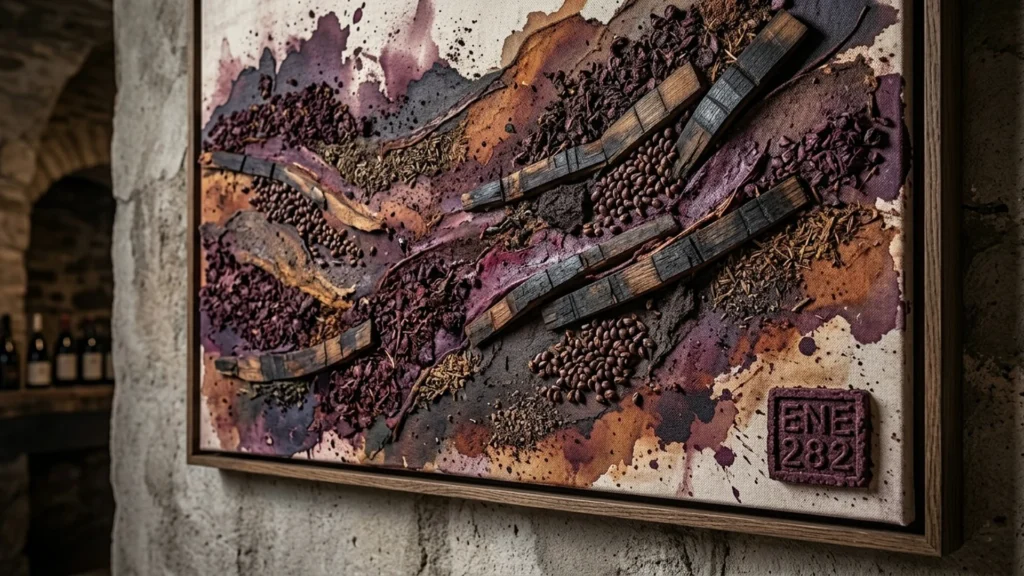
In THE BEGINNING, ENE 282 approaches Megixtone through matter. The work does not offer a conventional portrait of a bottle or a vineyard. It presents a rough, layered surface in which the making of wine becomes a starting point for another kind of transformation.
The artist’s reserved identity leaves the composition to carry the encounter. Before a biography or an explanation, there are textures, fragments and a diagonal movement that draws the eye across the frame.
THE BEGINNING, a landscape made of fragments
The project’s account of the work describes grape skins, seeds and fermentation residues among its materials, alongside charred wood. Each fragment brings a different texture and a trace of an earlier use into the composition.
Dark fragments interrupt a field of purple and earthy tones. The surface appears almost geological, as though different moments had accumulated into a single landscape. Its unevenness asks for close looking; the eye cannot take in every detail at once.
The diagonal gives those fragments direction. What could seem scattered becomes a movement, held between the irregularity of the materials and the decisions that place them together.
A seal within the irregular surface
Against that roughness, the square ENE 282 mark introduces a different kind of presence. Its geometric order provides a point of reference without making the surrounding material less unruly.
This tension is central to the reading of the work. Nature supplies forms that are not uniform; the artist gives them a relationship. The result can be understood alongside the story of Megixtone, where attention to an individual vision matters more than conformity to an expected model.
An origin rather than an ending
The title suggests a first moment: something breaks down and another possibility appears. A residue is no longer seen only in relation to the process that left it behind. It becomes part of a new object and a new way of looking.
As the opening work of the trilogy, THE BEGINNING establishes that question of transformation. Its force lies in the material’s refusal to become smooth or anonymous. The traces of its previous life remain present, even as a different story begins.