Megixtone Logo Text
  • About me
  • History
  • How to Purchase
  • Contact
  • News
  • Login
  • Register
  • Reserved Area
  • English
  • Italian

News

divider
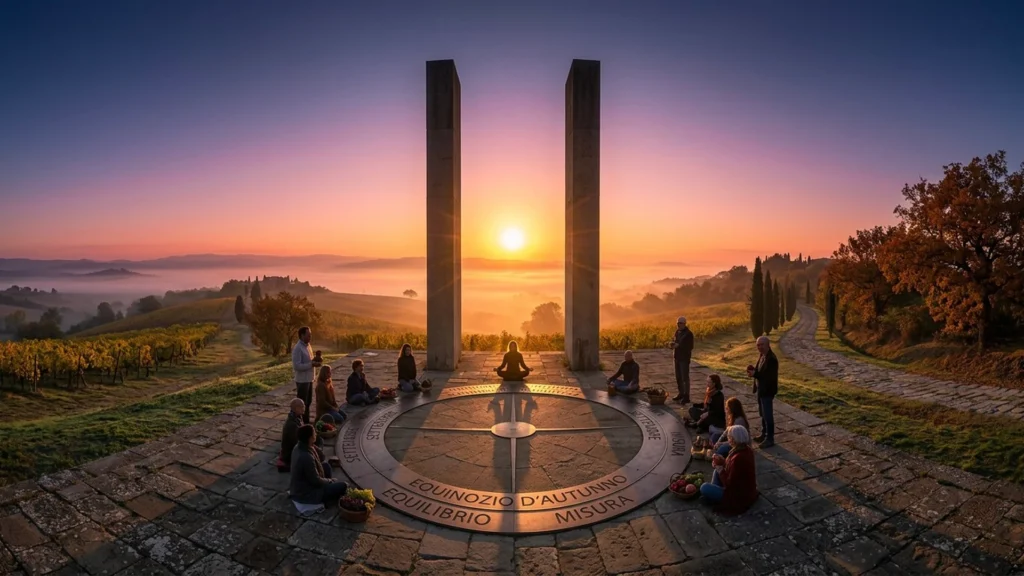
Sunset between two stone pillars above a circular platform, with vineyards and hills beyond.

The Autumn Equinox: Megixtone and the Search for Balance

23/09/2026
News

The Autumn Equinox: Megixtone and the Search for Balance

The autumn equinox marks a threshold. Summer’s light gives way to a different rhythm, and the vineyard enters a season that invites closer attention. In Italy, the September equinox falls on 23 September in 2026.

We often imagine this moment as a perfect division between daylight and darkness. In reality, their duration is only approximately equal: the US Naval Observatory explains why. The image remains powerful, however. Light and shadow seem to pause in conversation before the year moves on.

The autumn equinox as a threshold

Around this passage, the landscape changes gradually rather than all at once. The air feels different, the hours of light shorten and the vineyard’s colours begin to shift. A date marks the season while each vine continues to follow the conditions around it.

This distinction matters in the world of wine. Observation comes before a fixed timetable. Ripening, harvest and the work that follows depend on the conditions of each year, not on the appeal of a date.

The equinox offers Megixtone a symbolic meeting point between those two ways of understanding time: the calendar that measures it and the patient attention that gives it meaning.

Balance is not immobility

In the story of Megixtone, waiting is part of a deliberate search. Balance does not mean erasing character or making every element equally noticeable. It means allowing a wine’s different qualities to belong together without losing their identity.

Like the changing season, that relationship is alive. It asks for judgement, restraint and the willingness to wait when a quicker decision would be easier. The aim is not an abstract perfection imposed from outside, but a coherence that emerges through the work.

A different pace at the table

Autumn offers a fitting setting for that kind of attention. The scents of the countryside and the warmth of a table belong to the season; they need not become a prescribed tasting note. Each encounter with a wine deserves to be experienced on its own terms.

To pause with Megixtone at this time of year is to leave haste behind for a while. The season does not ask us to stop time. It asks us to notice the way it changes things.

Your next encounter with Megixtone

To learn about private allocations and the steps involved, explore how to purchase Megixtone.
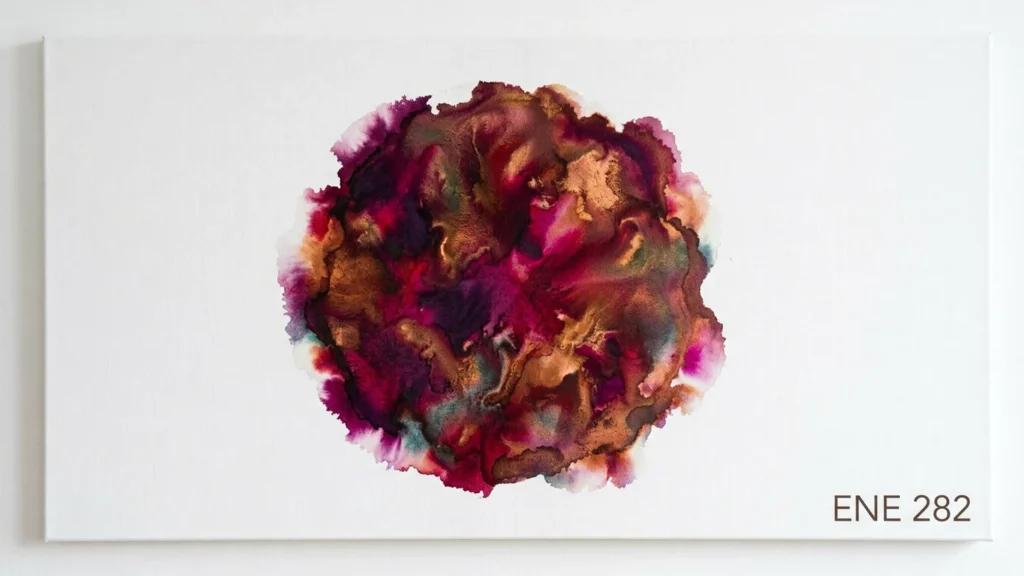
SOLVE by ENE 282, an organic red, purple and amber shape on a white canvas.

SOLVE: ENE 282 and the Art of Leaving a Trace

22/09/2026
News

SOLVE: ENE 282 and the Art of Leaving a Trace

With SOLVE, ENE 282 brings the trilogy inspired by Megixtone to a quieter conclusion. The dense fragments of THE BEGINNING and the spiral of ANCORA give way to a white canvas and a fluid field of colour.

The change is immediately visible. Where the earlier works draw attention to their physical weight, this composition allows space to become part of the experience. The eye no longer travels across a crowded relief; it follows an edge, a transition and the places where colour thins.

SOLVE and the gesture of dissolution

The title recalls the alchemical phrase solve et coagula, dissolve and coagulate. Here, that language is used as an artistic metaphor. The history of alchemy supplies a cultural background, rather than a scientific explanation of the work.

Dissolution means letting go of the structures that previously held the image together. There are no prominent wooden fragments to guide the reading. The mark itself becomes the subject.

In the project’s description, wine absorbed into the canvas provides that mark. Ruby, plum and amber tones suggest the changing appearance of organic colour, while the surrounding white gives each variation room to register.

What remains when material is removed

The composition does not feel empty simply because it contains less. Its open space makes the central form more insistent. A small change in density or outline becomes something the viewer can follow.

Read after ANCORA, SOLVE shifts the question from return to release. The earlier spiral held memory in a structure; this final image allows memory to appear as a trace.

The square ENE 282 signature remains a point of order. It connects the work to the preceding chapters without rebuilding their material weight.

The completion of a journey

The trilogy moves from assembled matter to a more restrained presence. Its conclusion is not a claim that the physical world has disappeared, but an invitation to notice how little may be needed to evoke it.

Megixtone remains the source of that reflection. In SOLVE, the wine is approached through what it leaves behind: a colour, a shape and the attention they continue to hold.

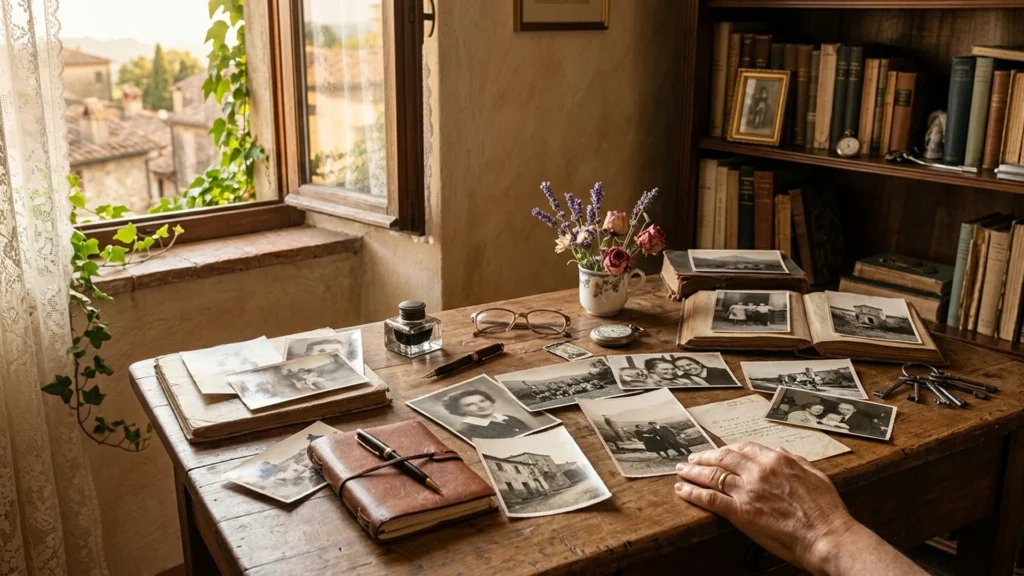
A hand beside old photographs and notebooks on a wooden desk overlooking the countryside.

Keeping Time: A Reflection for World Alzheimer’s Day

21/09/2026
News

Keeping Time: A Reflection for World Alzheimer’s Day

World Alzheimer’s Day, observed on 21 September, invites us to reflect on memory and on the lives of people affected by dementia. Behind the name of a condition are individual histories, relationships and everyday gestures that deserve attention.

Memory connects moments that might otherwise seem distant. A familiar voice, a photograph kept in a drawer, a story told around a table can become part of the way we understand our lives. When remembering becomes difficult, a person’s dignity and right to care remain unchanged.

Time as something to care for

Time has a particular place in the story of Megixtone. The project developed through fifteen years of research, experimentation and patient observation. Waiting was not an empty interval before the finished wine, but part of the work itself.

That experience offers a starting point for reflection, not a comparison between a bottle and a human life. Some things cannot be understood through speed or immediate results. They ask us to stay, to listen and to recognise what another person needs.

The attention usually reserved for an exceptional object matters infinitely more when it is directed towards people. A conversation does not lose its value because it has happened before. Being present need not depend on finding the right words.

What World Alzheimer’s Day asks of us

Wine is not a way to prevent or treat Alzheimer’s disease. This reflection makes no claim for protective effects or therapeutic benefits from drinking it. The subject here is care, not consumption.

The purpose of the day extends beyond remembering a date: it is an opportunity to learn about dementia, challenge stigma and recognise the work of families and carers. Alzheimer’s Disease International provides information about the awareness campaign and ways to take part.

For a project built around patience, the most meaningful response is a simple one: give time to others. Listen to their stories, make room for their presence and support the research and services that help them. The value of a shared moment is not measured by how long it will be remembered.

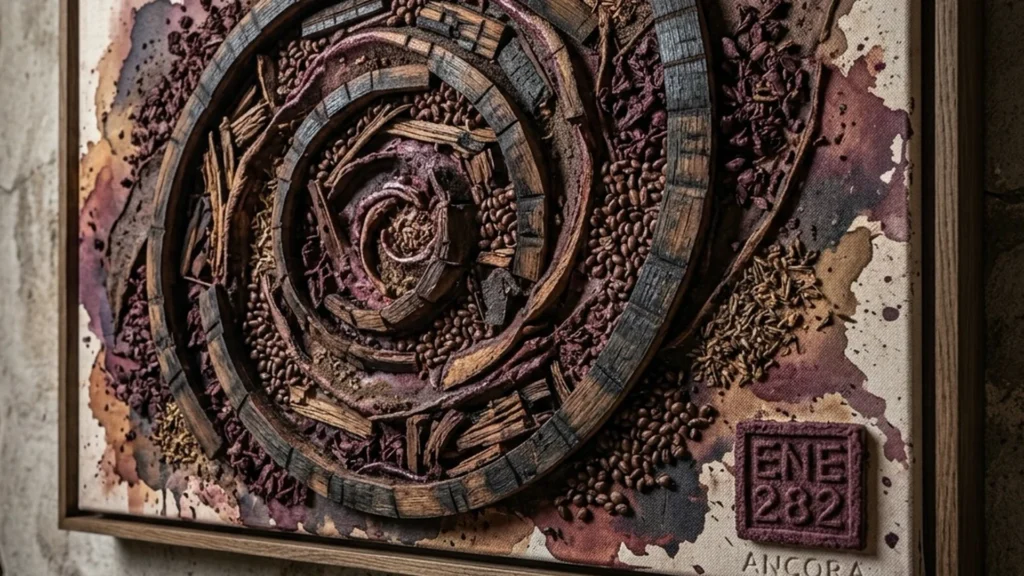
ANCORA by ENE 282, a spiral of curved dark wood over a textured purple surface.

ANCORA: ENE 282 and the Returning Movement of Time

20/09/2026
News

ANCORA: ENE 282 and the Returning Movement of Time

ANCORA turns the eye inwards. At the centre of the second work in ENE 282’s trilogy inspired by Megixtone, curved pieces of dark wood form a spiral. The movement appears to continue beyond the moment in which we begin looking.

After the diagonal tension of THE BEGINNING, this composition introduces a different relationship with time. Instead of an origin expressed through fracture, there is a return: the sense of passing through something familiar without arriving at exactly the same place.

The double meaning of ANCORA

In Italian, the title holds two words distinguished by their stress. Àncora means anchor; ancóra means again. One suggests a point of attachment, the other a renewed movement.

The anchor can be read as the bond with the earth and with what has already happened. It holds a memory in place. Again introduces the next harvest, the return of a season or the decision to begin once more.

The two meanings do not cancel each other out. A return has meaning because something remains recognisable; a point of belonging matters because life continues around it. The spiral gives this relationship a visible form.

A surface that keeps its traces

Wood and purple-toned textures create a relief rather than a flat image. In the description accompanying the project, organic residues and wine pigmentation contribute to that material language. Their role is expressive: they bring the memory of a process into the composition.

The curved fragments suggest motion while remaining fixed in place. This is where the work’s tension sits. Nothing on the surface needs to move for the eye to experience a continuing pull towards its centre.

The mark that steadies the movement

Near the lower edge, the ENE 282 seal and the title introduce geometric order. They give the viewer a point of reference against the turning form.

ANCORA therefore continues the trilogy without simply repeating its first gesture. The question is no longer only how matter can become something else, but what survives that change. In Megixtone’s symbolic world, the answer is a connection to origin that can be renewed rather than left behind.

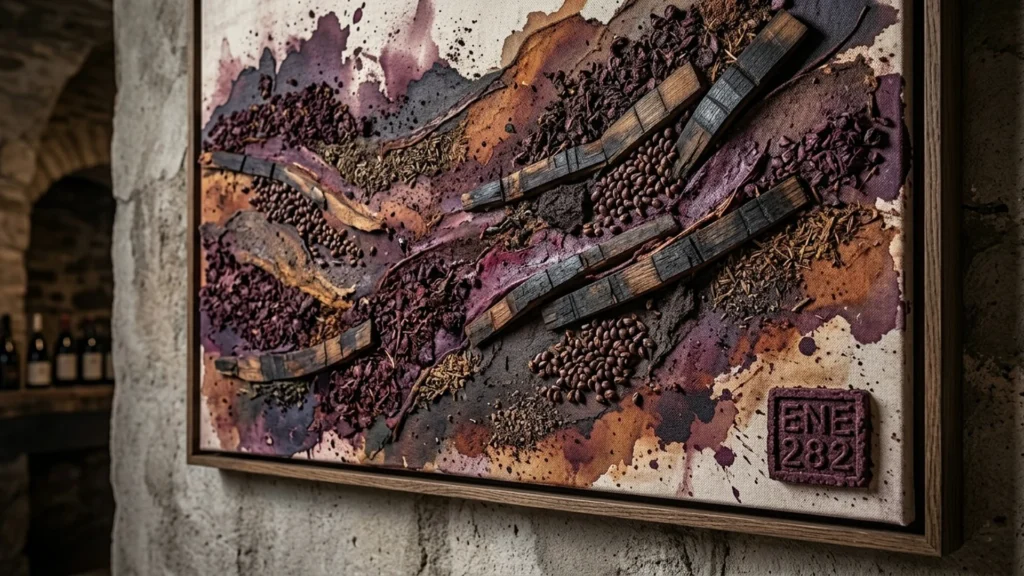
THE BEGINNING by ENE 282, with diagonal dark wood fragments and purple and earth-toned textures.

THE BEGINNING: ENE 282 and the Visual Genesis of Megixtone

19/09/2026
News

THE BEGINNING: ENE 282 and the Visual Genesis of Megixtone

In THE BEGINNING, ENE 282 approaches Megixtone through matter. The work does not offer a conventional portrait of a bottle or a vineyard. It presents a rough, layered surface in which the making of wine becomes a starting point for another kind of transformation.

The artist’s reserved identity leaves the composition to carry the encounter. Before a biography or an explanation, there are textures, fragments and a diagonal movement that draws the eye across the frame.

THE BEGINNING, a landscape made of fragments

The project’s account of the work describes grape skins, seeds and fermentation residues among its materials, alongside charred wood. Each fragment brings a different texture and a trace of an earlier use into the composition.

Dark fragments interrupt a field of purple and earthy tones. The surface appears almost geological, as though different moments had accumulated into a single landscape. Its unevenness asks for close looking; the eye cannot take in every detail at once.

The diagonal gives those fragments direction. What could seem scattered becomes a movement, held between the irregularity of the materials and the decisions that place them together.

A seal within the irregular surface

Against that roughness, the square ENE 282 mark introduces a different kind of presence. Its geometric order provides a point of reference without making the surrounding material less unruly.

This tension is central to the reading of the work. Nature supplies forms that are not uniform; the artist gives them a relationship. The result can be understood alongside the story of Megixtone, where attention to an individual vision matters more than conformity to an expected model.

An origin rather than an ending

The title suggests a first moment: something breaks down and another possibility appears. A residue is no longer seen only in relation to the process that left it behind. It becomes part of a new object and a new way of looking.

As the opening work of the trilogy, THE BEGINNING establishes that question of transformation. Its force lies in the material’s refusal to become smooth or anonymous. The traces of its previous life remain present, even as a different story begins.

A blue and gold celestial figure surrounded by flowing ribbons, stars and a crescent moon.

I Don’t Just Open Wine, I Share a Secret: My Idea of Luxury

18/09/2026
News

I Don’t Just Open Wine, I Share a Secret: My Idea of Luxury

For me, secret luxury begins where display stops being interesting. It is the understanding between people who recognise something without needing everyone else to recognise it too. That is the kind of relationship I wanted to create with Megixtone.

When I began, I was not looking for the widest possible approval. I wanted to follow a vision closely enough that the result would carry its own identity. A wine does not become meaningful to me simply because its name is familiar or its label is expected at a particular table.

I am interested in what happens when the familiar choice is set aside. There is room then for a different conversation: about the person behind a bottle, the decisions that shaped it and the reasons someone feels drawn to it.

Secret luxury and the freedom to choose

The word luxury is often used to describe what can be seen from a distance. My approach is more private. I want the work to have a strong character, even when that character will not please everyone.

This is not a contest in appearing more exclusive than somebody else. Rarity without a reason is only scarcity. What interests me is the relationship between limited availability and an uncompromising way of working.

Megixtone follows a path of private allocation. The process belongs to the same idea: an encounter should have meaning beyond the transaction. Possessing a bottle is not a promise of financial return, nor does it need to become a public statement.

What a bottle can say at the table

When I speak of sharing a secret, I mean sharing a story that has not yet become routine. The pleasure is not in excluding someone, but in making a discovery personal.

A table gives that discovery a setting. Someone asks a question, another person notices a detail, and the conversation moves beyond the usual names. The bottle has opened a space rather than supplied a ready-made answer.

That is the independence I want Megixtone to express. Its appearance and its character belong to a choice made from within, not to a demand for approval.

I do not expect everyone to see luxury this way. For those who do, the most valuable part may be precisely what cannot be displayed: the sense of having found something that speaks in a language of their own.

An invitation to discover Megixtone

If this vision speaks to you, I invite you to explore how to access private allocations.

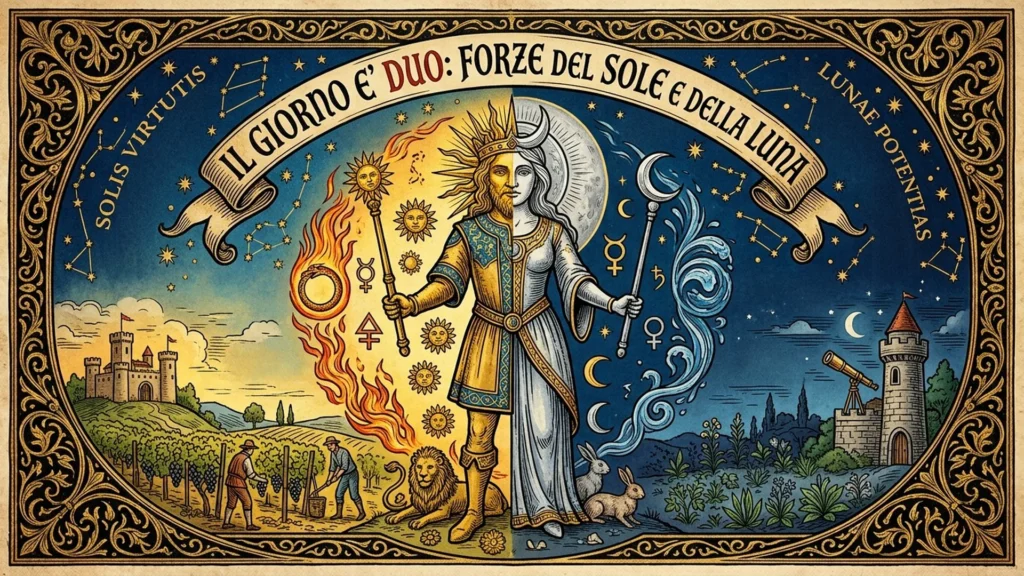
An illuminated manuscript showing an allegorical figure with a sun and moon inside an ornate border.

DUO and SON: How Megixtone Gives Time a Musical Language

17/09/2026
News

DUO and SON: How Megixtone Gives Time a Musical Language

DUO and SON are two names for the way Megixtone imagines a day. One describes the relationship between light and darkness; the other gives that changing relationship a musical voice. Together they form a personal language for observing time.

In the Megixtone calendar, thirteen months of twenty-eight days make 364 days. SON ATEM adds the final pause to the 365-day scheme. Within this symbolic architecture, each day can be considered as a distinct movement.

DUO and SON, two ways of reading a day

DUO names the pairing of daylight and darkness. Their changing duration provides a visible rhythm through the year, from winter’s shorter days to summer’s longer light.

The vineyard makes that passage tangible. A canopy, a shadow across the soil and the appearance of a bud all invite observation. The physiological life of a vine is real; DUO is the project’s way of turning attention towards it.

SON, inspired by the Latin sonus, introduces sound. Where DUO offers a proportion, SON suggests a mood, an intensity or a phrase. It is a poetic interpretation of the day, a way to imagine its character through sound.

A piece of music for each day

The concept associates each daily pairing with a piece of music: one DUO, one SON, one musical interpretation. Across the year, this becomes the idea of a sequence of 365 pieces.

Music can give form to differences that numbers alone do not convey. A sustained note suggests waiting; a pause can make the next sound more present. In the same way, looking at a vineyard repeatedly allows small changes to acquire meaning.

The connection does not depend on claiming that a particular frequency produces a particular flavour. It depends on the listener’s willingness to notice rhythm, contrast and duration.

Listening without a formula

For Megixtone, light and sound belong to a broader reflection on making wine. They offer images for the work’s changing pace and for the attention it asks of its creator.

DUO and SON give observation another vocabulary, carrying the dialogue between light and darkness into the act of listening. A day is no longer merely crossed off a calendar: it becomes something to look at, listen to and remember.

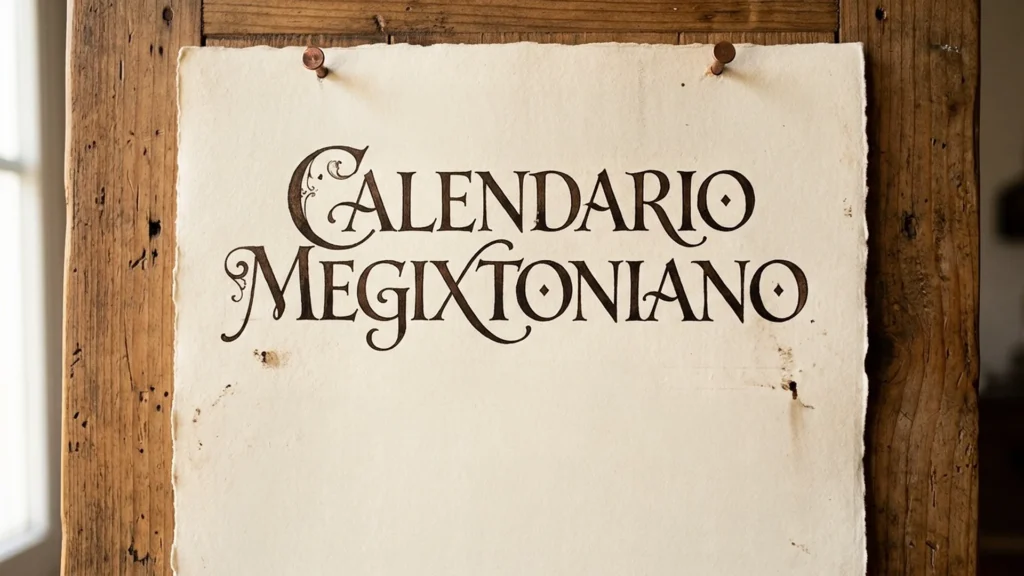
A parchment headed Calendario Megixtoniano hanging against weathered wooden boards.

The Megixtone Calendar: Thirteen Months of Transformation

16/09/2026
News

The Megixtone Calendar: Thirteen Months of Transformation

The Megixtone calendar gives the year a language of its own. Thirteen months of twenty-eight days describe a passage through rest, growth and transformation. Their names belong to the project’s symbolic world: a way to contemplate the life of wine, rather than a replacement for the agricultural calendar.

Thirteen times twenty-eight makes 364. A further day, SON ATEM, completes a 365-day cycle. This is a narrative structure, not an astronomical calendar or a timetable that determines when each vineyard operation must happen.

The thirteen months of the Megixtone calendar

IAN: the doorway. The cycle opens beneath the surface, in an image of winter stillness. Roots and earth seem to hold their breath. Rest is not the absence of a future harvest, but the quiet from which the story begins.

FEBRO: purification. The thought turns towards the return of sap and the vine’s reawakening. Its name evokes preparation: the moment before renewed growth becomes visible.

MAZ: vibration. The emerging bud becomes the centre of attention. Sound enters the narrative as an image of energy and expectancy, expressing the tension of life about to unfold.

APRI: opening. This is the gesture of unfolding, the passage from what is enclosed to what can meet the light. Flowering provides its symbolic image, without tying that event to a universal date.

MAIO: the green canopy. Leaves fill the view and the vineyard acquires a different density. The calendar turns from the promise of growth to its visible presence.

IUN: from flower to fruit. Fruit set marks a change in possibility. What began as a flower can become a berry, and the future harvest starts to take shape.

SOLI: the fullness of light. Conceived as the solstitial month, SOLI places sunlight at the centre of the story. It holds the image of summer at its most intense, when light seems to occupy the whole landscape.

IUL: the change of colour. Veraison becomes a threshold. The berries begin to change, and the vineyard can no longer be read as it was before.

GUSTI: the emergence of flavour. Sugar, acidity and aromas bring ripening into focus. The name suggests attention to what the fruit is becoming, not an instruction to harvest on a fixed day.

SETTI: fermentation. The scene moves towards the cellar. Yeasts transform sugars into alcohol, giving the calendar a tangible image of matter changing state and character.

OTTI: the descent into glass. Darkness and patience take over. Glass vessels belong to this chapter of Megixtone’s story, where the work becomes less visible but remains deliberate.

NOEM: settling. Gravity and time provide the central image. The month evokes clarification and quiet, as suspended particles slowly find their place.

DICEM: completion. The circle closes. Completion here means recognising the end of a passage before beginning another, rather than imposing a single finishing date on every wine.

SON ATEM, the pause outside the rhythm

In this symbolic scheme, 31 December is named SON ATEM. Atem is the German word for breath. The image is of a pause between phrases, a silence that allows the next movement to begin.

The calendar thus holds both a measured sequence and a space outside it. Its purpose is contemplative: it gives names to forms of attention that the ordinary succession of dates can conceal.

A personal language for the vineyard

These names are part of the world of Megixtone, where the language of music meets the changing appearance of the vineyard.

Their value lies elsewhere. By stepping outside the language of deadlines, the calendar asks us to look again at a familiar cycle. Rest, growth, transformation and waiting become moments to recognise, rather than time to get through.

Single-seater racing cars on a circuit, illustrating the contrast between speed and the slow creation of wine.

Between the Glass and the Stopwatch: Megixtone and The Out Lap

15/09/2026
News

Between the Glass and the Stopwatch: Megixtone and The Out Lap

A stopwatch and a wine glass seem to ask opposite things of time. One measures the fraction that can decide a result; the other invites us to slow down. The Out Lap, Formula 1’s travelling fine-dining experience, offers a setting in which to consider that contrast alongside Megixtone.

For the Monza edition on 4 and 5 September 2026, Formula 1 announced a menu by Massimo Bottura. The encounter between racing and cooking is the starting point for this reflection, not a collaboration between Megixtone and the event.

Megixtone and the time that cannot be hurried

Megixtone’s approach begins with accepting that some decisions cannot be brought forward simply because a deadline is convenient. The vineyard must be observed, the work reconsidered and the wine allowed the time its development requires.

In the history of the project, fifteen years of research and experimentation express that choice. They describe the gradual development of a vision, through choices that could not be settled in a single season.

Waiting, in this context, is active. It involves recognising a change, deciding whether to intervene and resisting the temptation to call something finished too soon. A quiet cellar can demand as much concentration as a place filled with movement.

The Out Lap and the culture of precision

The name comes from the lap a driver makes after leaving the pits. It is a moment of preparation before the next demand on the car and driver, rather than a lap returning to the pit lane.

Formula 1’s presentation of the Monza experience places Bottura’s cooking within a journey through the circuit. Racing provides the setting and its stories; dining gives guests a different way to experience them.

The food itself need not be hurried to express that world. Preparation and timing are already central to cooking. The contrast is therefore less between fast food and slow wine than between different disciplines of attention.

The detail that connects them

A racing result is measured publicly. The development of a wine is often judged in the privacy of repeated observations. Yet both invite a question: what happens when a small detail is treated as decisive?

For Megixtone, the answer is found in the refusal to let convenience settle a choice. The glass and the stopwatch remain different objects, but the care behind them makes their contrast worth considering.

From the story to the glass

To discover Megixtone beyond its story, learn about the private allocation process.

Christopher Columbus 1492 voyage: a sailing ship heading towards the horizon

Christopher Columbus’s 1492 Voyage: Beyond the Horizon with Megixtone

31/08/2026
News


Christopher Columbus’s 1492 Voyage: Beyond the Horizon with Megixtone

Christopher Columbus’s 1492 voyage remains one of history’s strongest images of an horizon turned into a question. Columbus, probably born in Genoa in 1451, reached the Caribbean during an expedition backed by the Crown of Castile. The Library of Congress account of Columbus and the Taino also makes clear that these islands were already home to peoples whose lives were profoundly and violently changed by European arrival.

Beyond legend, towards sources

Columbus’s story has produced many theories, genealogies, and alternative narratives. The claim that he was the illegitimate son of Pope Innocent VIII is not supported by established historical research and should not be presented as evidence. Setting aside an unproven thesis does not make the voyage less compelling; it makes the difference between a map, a source, and a wish easier to see.

Christopher Columbus 1492 voyage: vision and method

Sailing into uncertainty is not courage alone. It requires instruments, calculations, attention to wind, and decisions under pressure. This is the part of the metaphor that matters to Megixtone: a vision gains value when it is sustained by method, patience, and responsibility.

In wine, finding a personal route does not mean refusing knowledge. It means building a coherent practice. Megixtone presents fifteen years of study as the time needed to understand which gestures are necessary and which belong only to convention.

Discovery is never neutral

Speaking about 1492 today requires a complete view. The encounter between worlds was not an adventure without consequences; it opened an era of conquest, violence, and irreversible change. Recognising that complexity makes the metaphor more mature. This is not a celebration of conquest, but a question about the relationship between ambition and responsibility.

If you are interested in a project that seeks to move beyond limits without losing its roots, read Inside Megixtone. To learn about the selection path, request access information.

Older News »

logo

FAQ

P.IVA 02065410439 | COPYRIGHT MEGIXTONE ® 2024 | REGISTERED TRADEMARK

COOKIE POLICY (EU) | DICHIARAZIONE SULLA PRIVACY (EU) | PRIVACY POLICY (US) | OPT OUT PREFERENCES

WhatsApp us