


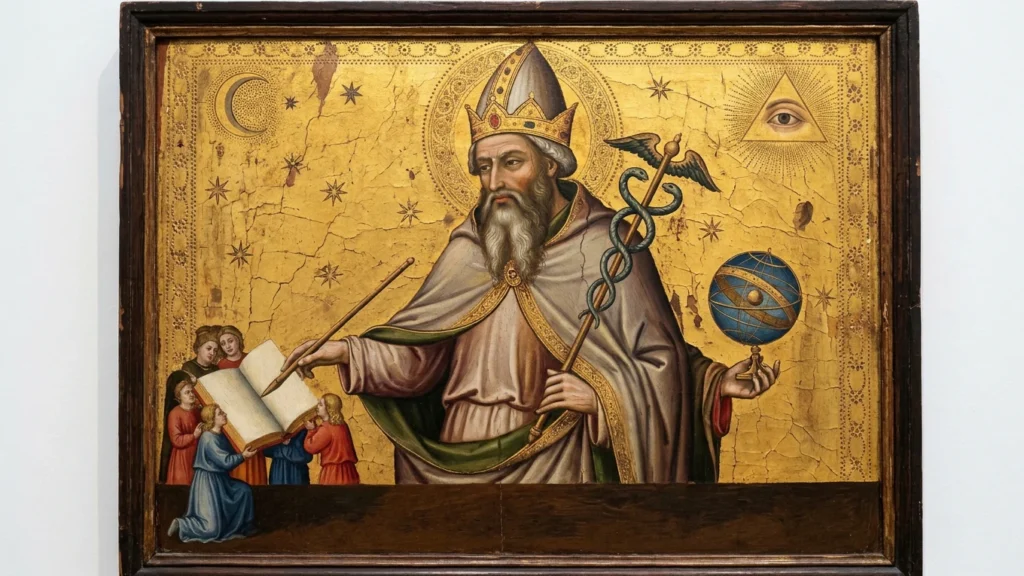
Megixtone Wine Philosophy: A Dialogue Between Art, Number and Harmony
Dear Collector,
Megixtone wine philosophy invites a reflection on the relationship between human intention and the natural world.
An idea takes shape through choices, study and work. As it becomes tangible, it also gathers meanings: the aspirations of its creator, the cultural references that accompany it and the questions it leaves open.
Renaissance philosophy offers a perspective from which to explore these relationships. Its encounters with classical thought, Hermetic writings and Jewish Kabbalah provide a starting point for a contemporary reading of MEGIXTONE.
Human Agency and the Work of Creation
Giovanni Pico della Mirandola’s writings bring different philosophical and religious traditions into conversation. His Oration, commonly known as the Oration on the Dignity of Man, considers the possibilities open to human beings in shaping their own nature.
This theme offers an analogy for creative work.
A project develops through the decisions of those who pursue it. An initial intuition meets practical demands; study gives direction to enthusiasm; experience leads to reconsideration.
Applied to MEGIXTONE, the analogy concerns the responsibility of giving form to an idea. The relationship between art and science becomes a meeting of imagination, knowledge and sustained effort.
Number and the Search for Order
In Pythagorean traditions, numbers and proportions offered ways of understanding order. The tetractys, formed from the first four positive integers, brings together one, two, three and four in a sum of ten.
Its interest here lies in the relationship between individual parts and a coherent whole.
That relationship offers a philosophical image for composition. A project acquires its character through the connections between its elements, and through the care with which those connections are considered.
Within this reading of MEGIXTONE, proportion becomes a question of coherence: how an intention, a method and an expression can belong together.
Kabbalistic Symbolism: Beauty and Understanding
Jewish Kabbalah offers another vocabulary for reflection.
Among the sefirot, Binah is associated with understanding, while Tiferet is associated with beauty and, in some interpretations, harmony.
These terms belong to a religious tradition with its own meanings and contexts. In this contemporary essay, they serve as references for considering the relationship between an expressive form and the thought behind it.
The connection with MEGIXTONE is an interpretative proposal: beauty inviting attention, and understanding developing through inquiry.
Musical Harmony and the Idea of Correspondence
The relationship between music and order also has a long philosophical history.
In the tradition transmitted by Boethius, musica mundana concerns the harmony of the world, while musica humana concerns harmony within the human being. These concepts extend the meaning of music beyond audible performance.
For MEGIXTONE, they offer an image through which to consider relationships between a project’s parts: rhythm and continuity, intention and execution, detail and overall form.
Musical harmony becomes a language for thinking about coherence. Its role in this reflection is philosophical and poetic.
Discretion and the Limits of Possession
The original reflection also raises a question about rarity: what does it mean to approach something reserved?
Discretion can leave space for a personal relationship with a project, allowing interest to develop through dialogue rather than public display.
Price and availability describe aspects of access. Understanding grows through attention, questions and the freedom to form an individual judgement.
A Contemporary Philosophical Reading
The dialogue between these traditions offers several perspectives on MEGIXTONE: human agency, numerical proportion, beauty, understanding and harmony.
Each retains its own history. Their meeting within this essay is a contemporary interpretation, shaped by the wish to consider how material work can also carry cultural meaning.
For the collector, this opens a conversation about the ideas surrounding the bottle and the significance they may hold personally.