


The Apollonia Theatre Tomb: A Megixtone Reflection on Time and Memory
What can an ancient burial and a bottle of wine offer to the same conversation?
The Apollonia theatre tomb provides an unexpected starting point. Its discovery brings together the physical remains of a place and the questions we ask when something from the past returns to view.
There is no historical connection with MEGIXTONE. The encounter proposed here is philosophical: a reflection on what endures, what passes and how we give meaning to each.
A Burial in an Unexpected Place
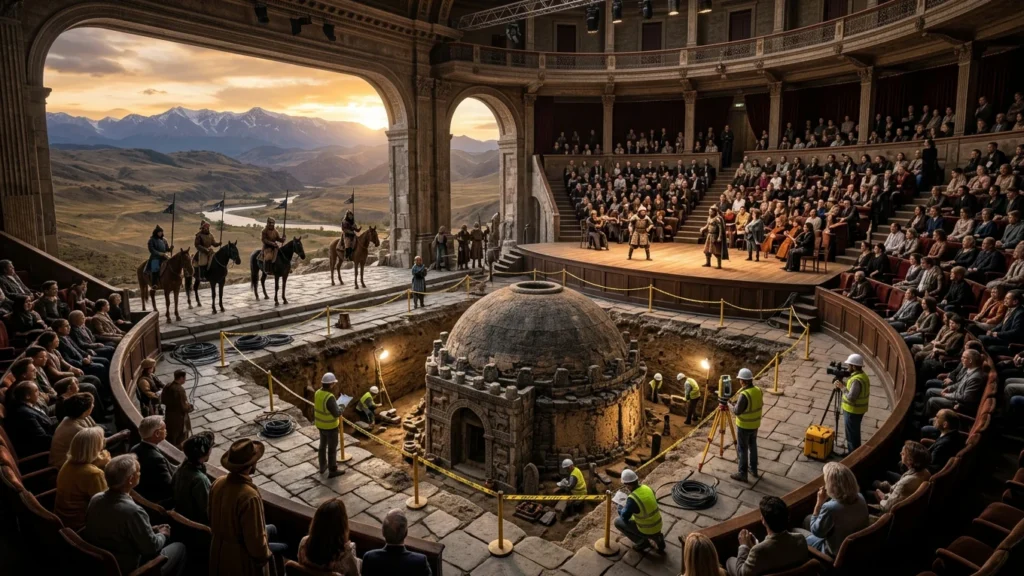
A report published by Anadolu Agency on 28 October 2026 described a tomb found in the lower seating area of the theatre at Apollonia ad Rhyndacum, in Gölyazı, Bursa province, Türkiye.
Dated to the first century AD, the burial contained cremated remains. Its location remains a question for the excavation team, particularly because the ancient city already had a necropolis. Anadolu Agency
The discovery invites attention before interpretation. Its archaeological meaning depends on research; its evocative power can also become the subject of a contemporary reflection.
The Theatre and the Passage of Life
A theatre gathers people for an experience that unfolds and comes to an end.
A performance occupies a limited span of time. Those present share it, then leave with memories that may differ from one another. The building can remain long after the voices and gestures have disappeared.
For a present-day observer, the image of a burial within that setting can evoke memento mori: a reminder of mortality.
This is a reading offered by the viewer. It leaves open the historical intentions of those who placed the burial there.
What Remains and What We Remember
Material survival and human memory follow different paths.
An object may endure while the name of its maker is lost. An encounter may leave no physical trace and still remain significant to those who experienced it.
The discovery at Apollonia brings these questions into focus. Something has survived, yet much of its story still requires patient reconstruction.
Its fascination lies partly in that distance between presence and understanding: we can see the remains before we know how to explain them.
Megixtone and the Meaning Given to an Object
Within the MEGIXTONE philosophy, the bottle also invites consideration of the ideas surrounding a material object.
The work behind a project, its intentions and the dialogue it opens with collectors can all contribute to its personal significance. That meaning develops through attention and familiarity.
The comparison with Apollonia concerns the questions we bring to objects: what do we preserve, what do we seek to understand and what makes something worth remembering?
The Value of a Passing Moment
Wine introduces another dimension to this reflection: the experience of something that changes and is shared over time.
An occasion cannot be preserved in precisely the form in which it occurred. Its setting, conversation and particular circumstances belong to a moment.
Recognising that limit can give the occasion its own significance. The memory may concern the people present, the attention exchanged or the conversation that continued afterwards.
In this reading, value can belong both to what is kept and to what is allowed to pass.
A Conversation Across Time
The Apollonia discovery and the MEGIXTONE philosophy meet here through a contemporary question about permanence.
A surviving structure asks us to reconstruct a past we cannot recover completely. A passing experience asks what we may wish to carry forward from it.
Both leave room for a considered relationship with time: preserving what can be preserved, acknowledging what remains unknown and giving attention to the present.
If this reflection resonates with your approach to collecting, we invite you to request a MEGIXTONE allocation and learn more about the project.