


Is Halloween an American Holiday? Looking Back at Its European Roots
With 31 October behind us, the carved pumpkins and autumn lights leave an interesting question: how American is Halloween?
Its familiar imagery owes much to American popular culture. Yet the European roots of Halloween reveal a longer history, shaped by seasonal customs, religious observances and migration.
Looking beyond the decorations opens a conversation about memory, the changing year and the stories through which communities give meaning to darkness.
Samhain and the Beginning of Winter
One important strand of this history leads to Ireland and the Gaelic festival of Samhain, traditionally associated with the beginning of winter.
Irish folklore surrounding this seasonal threshold includes encounters with the Otherworld, returning souls and customs intended to protect the home. These stories belong to a landscape of belief in which the boundary between ordinary life and the unseen could become uncertain.
The National Museum of Ireland preserves evidence of later Halloween customs, including frightening masks and carved turnip lanterns. They remind us that the festival’s history contains both remembrance and mischief, hospitality and apprehension. National Museum of Ireland
A History with Several Layers
Halloween also carries a Christian inheritance. Its name derives from All Hallows’ Eve, the evening before All Saints’ Day.
The celebration developed through the interaction of Christian observances and pre-Christian traditions. Its history is therefore better understood as a succession of encounters and changes than as a single ancient ceremony preserved intact. Library of Congress
This layered history gives the festival much of its fascination. A familiar image can hold meanings acquired in different places and periods.
The Journey Across the Atlantic
Nineteenth-century Irish migration helped bring Halloween traditions to the United States. There, the celebration continued to change, eventually becoming a widely shared occasion centred on costumes, fantasy and seasonal entertainment.
American culture played a substantial role in shaping the Halloween now recognised internationally. Its European inheritance and American development both belong to the story. UCLA
The journey across the Atlantic shows how a tradition can travel with people, take root elsewhere and return in a form that feels both familiar and new.
Italian Echoes: Remembrance, Gifts and Fire
Italy has its own customs surrounding the remembrance of the dead.
In Sardinia, traditions known by names including Is Animeddas and Su Mortu Mortu connect remembrance with offerings and visits from house to house. Local names and practices vary, preserving the character of individual communities. SardegnaTurismo
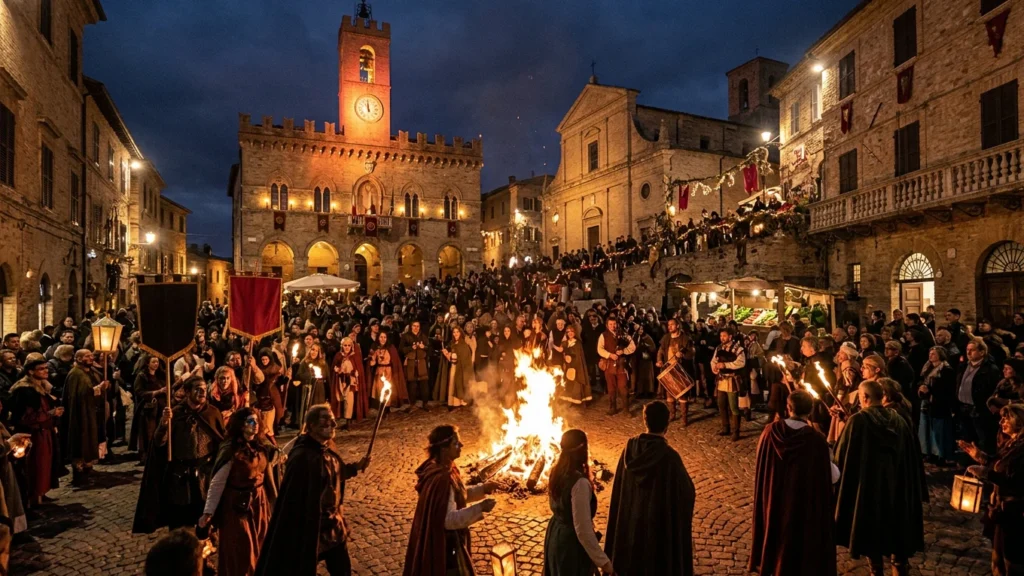
At Orsara di Puglia, Fucacoste e Cocce Priatorje takes place on 1 November. Bonfires and carved, illuminated pumpkins form part of a local tradition associated with the souls of the departed. Visit Orsara di Puglia
These customs offer meaningful comparisons with Halloween. Their similarities invite curiosity while each retains its own history and religious context.
Rome and the Image of an Open Threshold
Ancient Roman religion provides another image of contact with the unseen.
Writing about the opening of the mundus, Macrobius preserves a passage attributed to Varro that describes it as an opening towards the gods of the underworld. The image belongs to a specific Roman religious setting. Macrobius, Saturnalia, I.16
It can be considered alongside other representations of a threshold between worlds, without treating it as evidence of a direct origin for Halloween.
The comparison concerns a recurring question: how do people imagine their relationship with those who are no longer present?
The Marche: Cultural Encounters and Their Limits
The Marche region also bears witness to encounters between ancient peoples.
The National Archaeological Museum of Ascoli Piceno documents the settlement of the Senones in central and northern Marche during the fourth century BC, alongside evidence of Celtic objects farther south. National Archaeological Museum of Ascoli Piceno
This presence is part of the region’s history. Establishing that particular local autumn customs descend from Samhain would require additional evidence.
The distinction leaves the historical landscape open to inquiry, while allowing symbolic comparisons to remain recognisable as interpretations.
Autumn, Mystery and Megixtone
For MEGIXTONE, this journey through autumn traditions offers a philosophical point of reflection.
The season’s images invite us to consider time through change: a landscape becoming quieter, an evening drawing in, the memory of what has passed.
Mystery takes shape in what remains partly concealed. It can awaken curiosity about an origin, a story or the work behind an object.
These themes meet the MEGIXTONE philosophy through its interest in the rhythms of the earth, patience and the meanings gathered around wine.
A Reflection That Continues into November
The decorations may disappear, while the questions remain.
What do we choose to remember? How do we recognise the passing of a season? Which stories help us understand our relationship with the land?
Halloween’s varied history gives these questions an evocative setting. MEGIXTONE approaches them through a contemporary reflection on time, attention and the enduring appeal of mystery.