


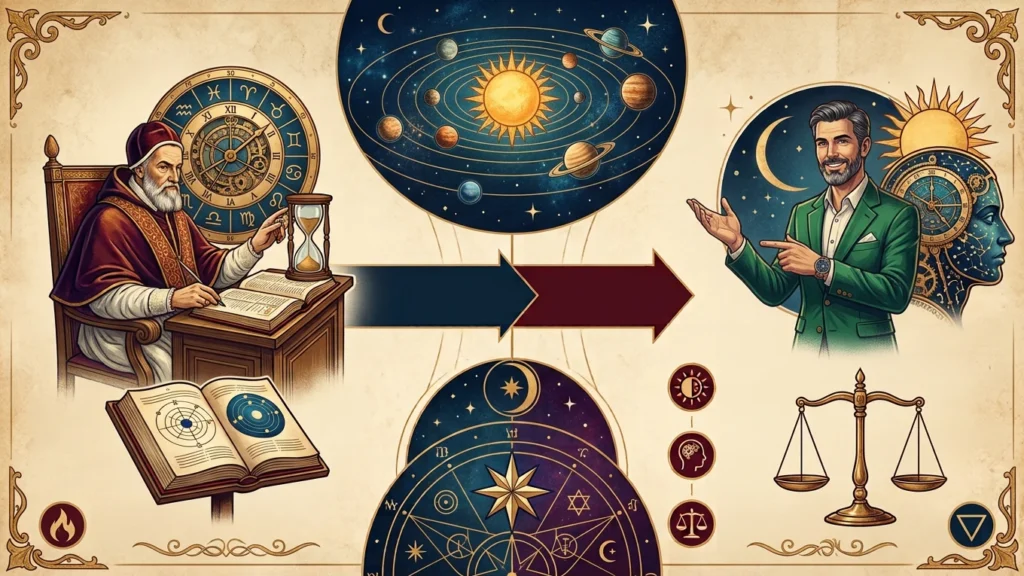
4 October 1582: The Gregorian Calendar and Time According to Megixtone
On 4 October 1582, an ordinary evening preceded an extraordinary change in the way dates were counted. In the territories adopting the Gregorian calendar that October, the following day was 15 October.
Ten dates disappeared from the calendar, but time itself continued uninterrupted. The reform introduced under Pope Gregory XIII corrected the accumulated discrepancy between the Julian calendar and the solar year, bringing calendar dates back into closer alignment with the seasons.
For Megixtone, this historical event offers a starting point for reflecting on how we measure time and what we choose to make room for within it.
The Gregorian Calendar and the Measure of Time
The reform drew on astronomical observation and mathematical calculation. It changed a shared convention to make it more closely reflect the natural cycle it was intended to describe.
Its resonance with Megixtone is symbolic: an invitation to consider whether the pace of our commitments leaves room for the experiences we value.
Not every occasion needs to follow the urgency of a deadline. Some deserve a place of their own.
Beyond the Pace of the Market
Collecting can involve release dates, changing trends and commercial expectations. Within that landscape, Megixtone places particular value on a personal relationship with time.
A bottle can be kept for an occasion that matters to its owner. The choice of when to open it need not become a response to fashion or an obligation imposed by the calendar.
What matters is the meaning of the occasion, rather than the pressure to create one.
Seasons, Attention and Personal Choice
The succession of the seasons provides a familiar way to observe change. In Megixtone’s narrative, that rhythm becomes a language for patience, attention and discretion.
This is not a prescribed timetable. It is a perspective that leaves room for individual choices: the setting, the company and the place an experience holds among other moments.
Making Room for What Matters
The transition of October 1582 reminds us that a system for measuring time can be reconsidered.
For Megixtone, the parallel lies in questioning habitual urgency and giving chosen occasions their proper space. Time is not something a bottle can alter. The decision is how we choose to spend it.
Observe the rhythm. Choose with care. Give time its measure.